
- 1. They Share a System, But They're Not the Same Platform
- 2. The Core Differences at a Glance
- 3. When Facebook Ads Work Better
- 4. When Instagram Ads Work Better
- 5. Audience Behaviour: What Actually Matters
- 6. Matching Platform to Business Goals
- 7. Which Costs More?
- 8. Same Business, Two Different Results
- 9. You Don't Have to Choose Just One
- 10. So, Which Should You Choose?
- 11. Frequently Asked Questions
- 12. Conclusion
You're ready to run ads. Budget's set, offer is ready, and then you hit the question almost every business owner faces: Facebook or Instagram?
Both platforms run through Meta Ads Manager, which means the same targeting tools, the same campaign setup, and the same billing system. But that's where the similarity ends. The people using each platform behave differently, expect different types of content, and respond to ads in different ways.
This guide will help you figure out which platform fits your business — based on your audience, your goals, what you're selling, and what you actually want people to do after seeing your ad.
1. They Share a System, But They're Not the Same Platform
Meta Ads Manager lets you run campaigns on Facebook, Instagram, or both — from one place. Many advertisers treat them as interchangeable, which is a mistake.
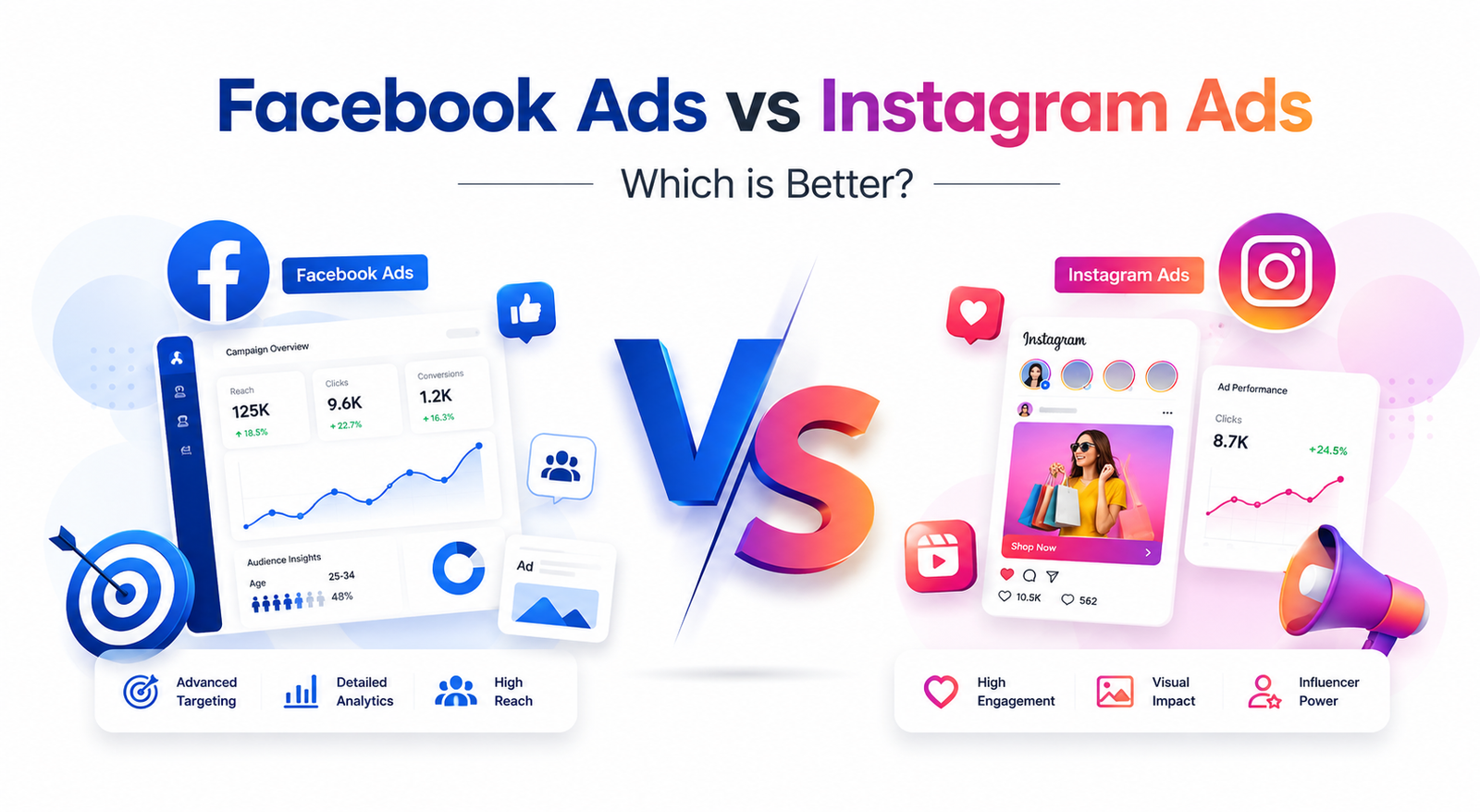
Facebook and Instagram attract different types of attention. Facebook users tend to read, click links, join groups, and research before making decisions. Instagram users scroll visually, discover products passively, and engage through likes, saves, and shares. Same ad budget, same targeting options, but very different behaviour on the other side of the screen.
Understanding that difference changes how you approach both platforms.
2. The Core Differences at a Glance
| Factor | Facebook Ads | Instagram Ads |
|---|---|---|
| Primary Audience Behaviour | Information and community-driven | Visual and discovery-driven |
| Content Format | Text, images, videos, groups, links | Images, videos, Stories, Reels |
| Engagement Style | Discussions and clicks | Likes, shares, saves, and visual engagement |
| Purchase Journey | Research and consideration | Discovery and impulse interest |
| Best For | Lead generation and local businesses | Brand awareness and visual products |
3. When Facebook Ads Work Better
You Want to Generate Leads and Inquiries
Facebook's lead generation tools — including native lead forms that don't require users to leave the app — are among the best in paid advertising. If you want people to fill in a form, book a call, or request a quote, Facebook generally outperforms Instagram for this specific goal.
Your Customers Need More Information Before Buying
Some products and services require explanation. A business coaching programme, a financial service, a B2B software tool — these aren't things people buy on impulse after one scroll. Facebook gives you room to use longer copy, include links to landing pages, and reach people who are actively researching options.
You Target Local Communities or Specific Demographics
Facebook's audience targeting by location, age, interests, job title, and life events is detailed. Local businesses — gyms, restaurants, clinics, estate agents — often see strong results because they can reach specific people in a specific postcode with messaging that speaks directly to them.
You Need Website Traffic or Form Submissions
If driving clicks to a website or landing page is the primary goal, Facebook typically delivers stronger results. Instagram users are more likely to stay within the app; Facebook users are more accustomed to clicking through to external pages.
4. When Instagram Ads Work Better
You Have Visually Appealing Products or Services
Instagram was built around images and video. If what you're selling looks good — fashion, food, interiors, skincare, travel, fitness — Instagram puts that visual front and centre. A single strong image or a short Reel can do more selling than a paragraph of copy ever could.
Instagram is a discovery platform. People aren't necessarily searching for your product, but they find it anyway because it showed up between posts from accounts they follow. For building brand recognition among people who don't know you yet, Instagram is effective and often more cost-efficient than Facebook for this goal.
Your Audience Is Highly Active on Mobile
Instagram is a mobile-first platform. If your customer is typically on their phone — younger audiences especially — Instagram puts your ad where their attention already is. Stories and Reels in particular are consumed in full-screen, which means your ad takes up the entire screen rather than competing with other content around it.
You Want Higher Engagement Through Visual Content
If engagement matters to your campaign — getting people to save posts, watch videos, or interact with your content — Instagram consistently produces higher engagement rates than Facebook for visual content. That engagement also builds social proof over time.
5. Audience Behaviour: What Actually Matters
Age gets talked about a lot in platform comparisons, but it's less useful than understanding how people on each platform interact with businesses.
How Facebook Users Typically Interact With Businesses
Facebook users often visit business pages before making a decision. They read reviews, check posting history, look for credibility signals. When they see an ad, they're more likely to click through to a website, read more information, and compare options. This makes Facebook particularly useful when there's a longer consideration period before purchase.
How Instagram Users Discover Brands and Products
Instagram users encounter brands passively. They weren't searching for you — your ad or your post appeared while they were browsing. That discovery moment is the opportunity. If what they see is visually compelling and the offer is clear, they'll stop scrolling. If it isn't, they won't. Instagram rewards creative quality more immediately than Facebook does.
Why Customer Intent Matters More Than Platform Popularity
The question isn't which platform has more users. The question is: what is your customer thinking and doing when they're most likely to buy from you? If they're researching and comparing, Facebook puts you in front of them at the right moment. If they're discovering and feeling inspired, Instagram does.
6. Matching Platform to Business Goals
For Lead Generation
Facebook is the stronger choice. Lead forms, longer copy, and the ability to drive traffic to landing pages all support the goal of getting inquiries and contact details. Instagram can work for lead generation, but it takes more creative work to get the same result.
For Brand Awareness
Instagram has an edge here. The visual-first format, high mobile usage, and full-screen Stories placements make it well-suited for putting your brand in front of new audiences in a way they actually remember.
For Website Traffic
Facebook drives more clicks to external websites. Instagram users are less inclined to leave the app, which means conversion rates from Instagram to a website are typically lower unless the offer is very compelling and the landing page is fast and mobile-optimised.
For Product Sales
It depends on the product. Clothing, beauty, homeware, food — Instagram. Business software, professional services, high-consideration purchases — Facebook. Products that are visually simple but functionally valuable often perform better on Facebook, where copy does more of the work.
For Building Community and Engagement
Facebook Groups remain one of the most effective tools for community building in paid and organic social. If your business model involves building an audience of engaged followers — for a course, a membership, a local service — Facebook Groups combined with Facebook Ads can produce strong long-term results. Instagram builds followers; Facebook builds communities.
7. Which Costs More?
There's no straightforward answer, and anyone who gives you one is guessing.
Ad costs on both platforms depend on your industry, the size of your target audience, how competitive that audience is, your campaign objective, the quality of your creative, and the time of year. A local plumber targeting homeowners in one city will pay very different rates than an e-commerce brand targeting fashion buyers nationally.
What matters more than cost per click or cost per thousand impressions is cost per result — meaning, what does it actually cost you to get a lead, a sale, or a new customer? A platform that charges more per click but delivers buyers rather than browsers is worth more than a cheaper platform that delivers curiosity.
Test both. Measure what each platform costs you per actual outcome, not per interaction.
8. Same Business, Two Different Results
An online clothing store runs campaigns on both platforms with the same budget split evenly between them.
The Facebook campaign drives consistent website traffic. It reaches people who've been browsing similar brands, clicks through to product pages, and generates a steady stream of visitors who read descriptions and compare options. The conversion rate from Facebook is modest but reliable.
The Instagram campaign generates stronger visual engagement. Short product videos and lifestyle images drive saves and shares. Fewer people click through immediately, but brand searches increase noticeably over the following weeks. Some of those people find the website through search and convert later.
Neither campaign is a failure. They're doing different jobs. Facebook is bringing in considered buyers. Instagram is building recognition that pays off over time. The business that understands this runs both intentionally rather than comparing them against the same metric.
9. You Don't Have to Choose Just One
Many businesses treat this as an either/or decision when it doesn't have to be.
Benefits of Running Campaigns Across Both Platforms
Running on both gives you reach across different types of user behaviour. Some of your potential customers are on Facebook but rarely use Instagram. Others are on Instagram constantly and rarely open Facebook. If you're only on one, you're missing part of the audience that might buy from you.
How Meta Automatically Optimises Placements
When you set up a campaign in Meta Ads Manager, you can choose Advantage+ Placements, which lets Meta automatically decide where to show your ad based on where it's most likely to perform. This can work well for awareness campaigns, though for more specific goals it's often worth controlling placements manually once you have some performance data.
Why Testing Both Often Produces Better Results
The fastest way to find out which platform works for your business is to run small test campaigns on both and compare the actual results. Not click-through rates or impressions — but the actions that matter: leads, sales, bookings. What the data shows about your specific audience and offer will tell you more than any general comparison.
10. So, Which Should You Choose?
- Want leads, inquiries, or form submissions
- Sell a product or service that requires explanation before purchase
- Target a local area or a specific demographic group
- Need people to visit your website and read more before converting
- Sell something that photographs or films well
- Want to build brand recognition among new audiences
- Rely heavily on video content and creative visuals
- Serve an audience that's predominantly on mobile
- Have multiple goals running simultaneously — awareness and conversions
- Want to maximise reach across different audience behaviours
- Can test creative on both platforms and optimise based on results
11. Frequently Asked Questions
Are Facebook Ads better than Instagram Ads?
Neither is universally better. Facebook tends to outperform Instagram for lead generation and website traffic. Instagram tends to outperform Facebook for visual brand awareness and engagement. The better platform depends entirely on what your business is trying to achieve.
Which platform is cheaper for advertising?
Costs vary significantly by industry, audience size, and campaign type. Instagram sometimes has lower costs per engagement, while Facebook can have lower costs per click to a website. Compare cost per actual result — not cost per click — to get a meaningful answer for your specific campaigns.
Which platform gets better conversions?
For direct conversions (sales, sign-ups, bookings), Facebook generally has higher conversion rates from ad click to action because users are more accustomed to clicking through to external pages. Instagram can drive strong conversions for straightforward e-commerce purchases, particularly when ads link directly to product pages.
Can I run ads on both platforms at the same time?
Yes. Meta Ads Manager manages both from one place. You can run the same ad across both, or create separate campaigns tailored to each platform's audience and format. Many businesses do exactly this.
How do I know which platform is right for my business?
Start with a small test budget on both. Run campaigns with the same goal, compare the cost per result, and let the data guide where you put more budget. Your industry, creative quality, and target audience will have more influence on the outcome than any general recommendation.
12. Conclusion
Facebook Ads and Instagram Ads run on the same system but serve different purposes. Facebook is where considered decisions get made — where people research, compare, and click through. Instagram is where discovery happens — where people find brands they weren't looking for and decide they want to know more.
The right choice depends on what your customer is doing when they're most likely to take action, and what you need them to do after they see your ad.
For most businesses, the strongest strategy eventually involves both — not because more is always better, but because different customers are in different places at different stages of deciding to buy from you. Understanding how each platform contributes to that journey is more useful than declaring a winner.
Launch High-Converting Ads with AMVIZ Digital
Our social media advertising experts build visual assets, write ad copy, and structure campaigns that scale leads and sales across Meta.