
- 1. What Is Branding?
- 2. What Does Branding Actually Include?
- 3. Why Is Branding Important for a Business?
- 4. How Strong Branding Influences Buying Decisions
- 5. A Simple Example of Branding in Real Life
- 6. What Happens When a Business Has Weak Branding?
- 7. How to Build a Strong Brand From Scratch
- 8. Common Branding Mistakes Businesses Make
- 9. Frequently Asked Questions
- 10. Conclusion
Why do some businesses pop into your head the moment you think of coffee, running shoes, or online shopping — while others, despite offering similar products, are completely forgotten? It's not luck. It's not always the biggest budget. More often than not, the answer is branding.
Branding is what separates businesses people remember from businesses people scroll past. It shapes how customers feel about you before they've even made a purchase — and long after they have.
In this guide, you'll learn exactly what branding is (and what it isn't), why it matters more than most businesses realise, how it influences buying decisions, and the practical steps you can take to build a strong brand from scratch.
1. What Is Branding?
At its core, branding is the way people perceive your business. It's the overall impression — the thoughts, feelings, and associations — that come to mind when someone encounters your company, product, or name.
"Your brand is what people say about you when you're not in the room."
Jeff Bezos
That definition matters because it shifts the focus from what you create to what people experience. Branding isn't just your logo, your colour palette, or your business name. Those are elements of your brand identity — the visible, designed parts — but branding itself is much deeper.
Branding shapes customer perception. It answers the questions customers ask (often unconsciously) before they decide to trust you:
- Is this business legitimate?
- Does this feel like it's for me?
- Can I trust this company with my money?
Done well, branding answers all three before the customer even reads a single line of copy.
2. What Does Branding Actually Include?
One of the most common misconceptions is that branding is just design. It isn't. Branding touches nearly every part of how your business shows up in the world.
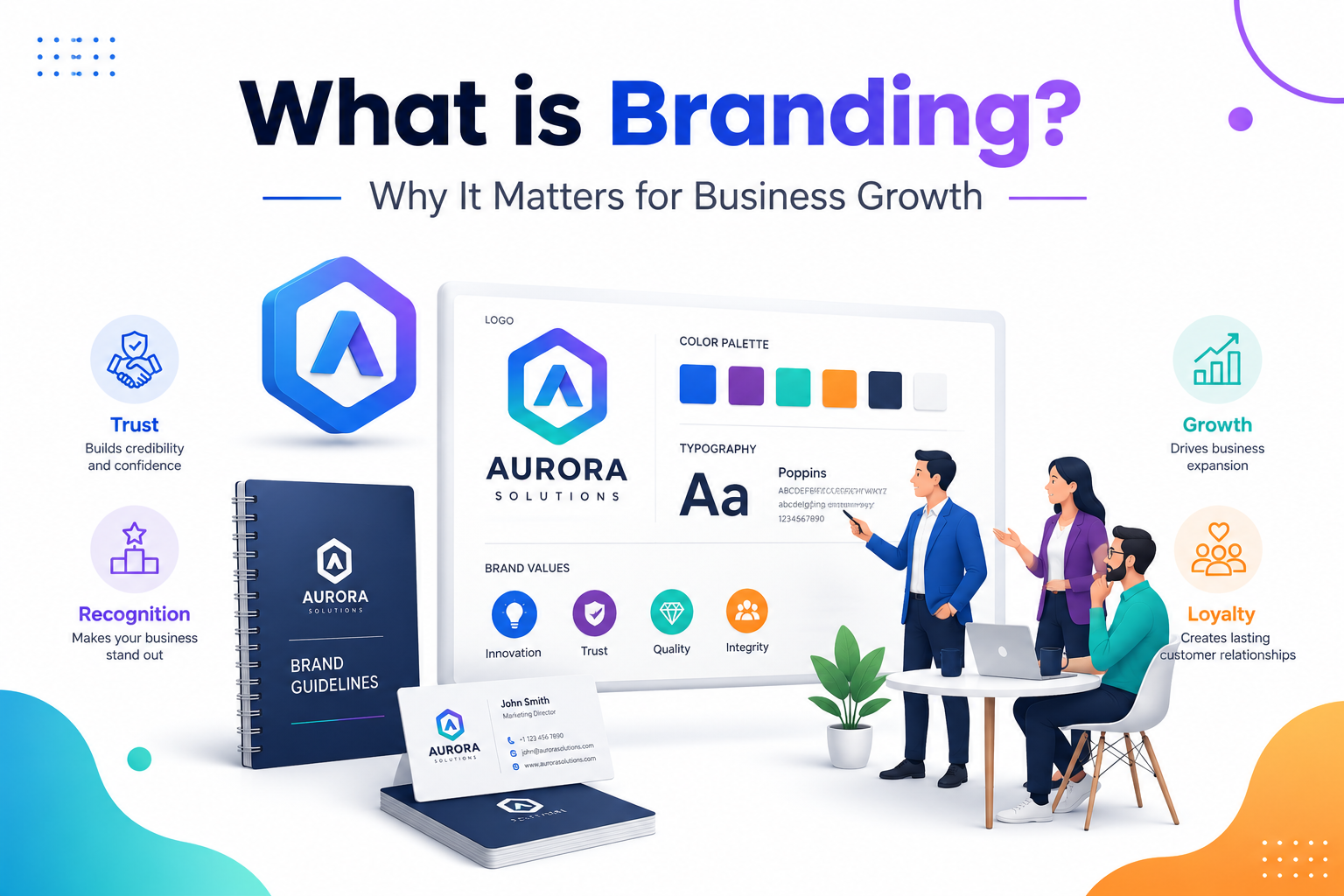
Brand Identity
This is the visual layer — your logo, colours, typography, packaging, and design style. It's what people see, and it's often the first impression your brand makes. Strong visual identity is consistent and recognisable across every touchpoint.
Brand Voice and Messaging
How your business sounds in words. Are you formal or conversational? Serious or playful? Authoritative or approachable? Your brand voice runs through your website copy, social media posts, emails, and customer support — and it should feel consistent regardless of who's writing it.
Brand Values and Personality
What your business stands for. What it believes in. What it would never compromise on. Customers increasingly choose brands whose values align with their own — and businesses with clearly defined values attract the right audience while filtering out the wrong one.
Customer Experience
Every interaction someone has with your business is a branding moment — from how easy your website is to navigate, to how quickly your team responds to a complaint, to the way a product is packaged when it arrives. Experience is branding in action.
Reputation and Trust
Reputation is branding that's built over time through consistent action. Reviews, word-of-mouth, industry recognition, and how you handle problems publicly all shape your brand in ways that no logo ever could.
3. Why Is Branding Important for a Business?
This is the question most business owners are really asking. Here's why branding isn't— it's foundational.
Helps People Recognize and Remember You
We live in a noisy world. Consumers are exposed to thousands of messages daily. Strong branding — consistent colours, a distinctive voice, a clear identity — makes your business instantly recognisable. Recognition builds familiarity, and familiarity builds trust.
Builds Trust Before Customers Buy From You
A polished, consistent, professional brand signals reliability. When someone lands on your website or sees your social media page for the first time, they're making a snap judgement. Weak branding raises doubts. Strong branding removes them.
Makes You Different From Competitors
In most industries, products and prices are similar. Branding is often the actual differentiator. It answers the question: Why should I choose you over everyone else? When you brand with clarity and intention, the answer becomes obvious.
Creates Emotional Connections With Customers
People don't just buy products — they buy how those products make them feel. Branding creates meaning. It connects your business to something customers care about: identity, aspiration, community, values. Emotional connection is one of the strongest drivers of purchasing decisions.
Encourages Loyalty and Repeat Business
Customers are loyal to brands, not just products. When someone identifies with your brand — when it reflects their values or makes them feel something — they come back. They also recommend you to others. A strong brand turns one-time buyers into long-term advocates.
Supports Long-Term Growth
Every marketing campaign, every product launch, every new hire benefits from a strong brand underneath it. Branding compounds over time. The investment you make today in defining who you are makes everything easier — and cheaper — in the future.
4. How Strong Branding Influences Buying Decisions
First impressions happen fast — research suggests within a fraction of a second. Before a customer reads your headline or checks your pricing, they've already formed an initial feeling about your business based on what they see and sense.
From that first impression onward, branding influences every step of the buying journey:
- Recognition reduces the effort required to make a decision. People default to what they know.
- Trust lowers the perceived risk of spending money. A credible brand feels safer to buy from.
- Emotional resonance can override rational comparison. Customers often choose the brand that feels right over the one that's objectively cheapest or fastest.
Strong branding doesn't manipulate — it communicates. It tells customers clearly, consistently, and confidently: this is who we are, this is what we believe, and this is what you can expect.
5. A Simple Example of Branding in Real Life
Forget global giants for a moment. Here's a scenario that plays out on high streets and in local markets every day.
Two coffee shops open on the same block. Both serve similar coffee. Both charge similar prices. Both have pleasant staff. Yet within six months, one has a queue out the door while the other is struggling.
Why?
The first coffee shop has a clear identity — warm, independent, community-focused. Its name, interior design, and logo all tell the same story.
It delivers a consistent experience — the same greeting, the same quality, the same atmosphere every single time. Customers know exactly what they're walking into.
Its messaging is memorable — a simple tagline that captures the feeling of the place. People repeat it to friends.
Most importantly, it has earned trust through consistency. Regular customers don't think twice about going back. They bring friends. They post photos. They become part of the brand's story.
The second shop has good coffee. But it has no clear story, no consistent experience, nothing that makes it feel distinct. So customers have no particular reason to choose it over anywhere else — and even less reason to recommend it.
That's the difference branding makes. Not just for global companies, but for the business around the corner.
6. What Happens When a Business Has Weak Branding?
Branding isn't just a "nice to have." The absence of strong branding has real consequences.
Customers Forget the Business
Without a distinctive identity, there's nothing to anchor a customer's memory. They had a perfectly fine experience — they just can't remember your name when it's time to buy again.
Marketing Becomes More Difficult
When your brand isn't clear, your marketing has no foundation to stand on. You end up spending more money, producing more content, and running more campaigns — just to get the same recognition that a well-branded business earns automatically.
Price Becomes the Only Competitive Advantage
Weak brands compete on price because they have nothing else to offer. This is a race to the bottom — one that eventually becomes unsustainable.
Trust Takes Longer to Build
Inconsistency breeds doubt. If your website looks different from your social media, which looks different from your packaging, customers start to question whether your business is reliable. Trust that could be built in seconds takes months instead.
7. How to Build a Strong Brand From Scratch
You don't need a big budget or a design agency to start building a brand that works. You need clarity, consistency, and commitment.
Define Your Purpose
Why does your business exist beyond making money? What problem are you solving? What change are you trying to create? Purpose gives your brand direction and makes it easier to make every decision that follows.
Understand Your Audience
Strong brands aren't built for everyone. They're built for someone — a specific type of person with specific needs, values, and preferences. The more clearly you understand your ideal customer, the more precisely you can build a brand that resonates with them.
Decide What Makes You Different
What can you offer that your competitors don't — or won't? Your point of difference doesn't have to be dramatic. It could be your approach, your values, your specialisation, or simply how you make people feel. Define it clearly, then build everything around it.
Create a Consistent Identity
Design a visual identity that reflects your brand's personality. Choose colours, fonts, and a logo style that tell the right story. Then use them — consistently — across every channel and every touchpoint.
Communicate the Same Message Everywhere
Your website, your social media, your emails, your packaging — all of it should sound and feel like it's coming from the same place. Inconsistency confuses customers. Consistency builds recognition.
Deliver an Experience That Matches Your Promise
The most powerful branding in the world can't survive a broken customer experience. Make sure what you promise in your marketing is what customers actually receive. Trust is built in moments of delivery, not moments of advertising.
8. Common Branding Mistakes Businesses Make
Even well-intentioned businesses make these errors. Knowing them helps you avoid them.
- Treating branding as just a logo. A logo is the face of your brand, not the brand itself. Investing in design without investing in clarity, values, and voice produces beautiful assets that don't connect with anyone.
- Trying to target everyone. A brand that speaks to everyone resonates with no one. The more specific your audience, the stronger your brand's appeal to that audience.
- Being inconsistent across channels. Customers encounter your brand in multiple places. If those experiences feel disconnected, trust erodes. Consistency is one of the most important (and underrated) elements of strong branding.
- Copying competitors. It's natural to look at what others in your industry are doing — but copying them puts you in their shadow permanently. The best brands define their own path.
- Ignoring customer experience. Everything your customer sees, hears, and feels is a branding moment. Overlocking the experience side of branding means your brand lives only in your materials, not in your customers' minds.
9. Frequently Asked Questions
Is branding only for large companies?
Not at all. Branding matters for businesses of every size. In fact, small businesses often benefit more from strong branding because it helps them compete with larger, better-resourced competitors by standing out clearly and building loyalty early.
What's the difference between branding and marketing?
Branding is who you are. Marketing is how you tell people about it. Branding defines your identity, values, and promise. Marketing uses campaigns, content, and channels to spread that message. Strong marketing built on weak branding rarely works for long.
How long does it take to build a strong brand?
There's no fixed timeline. Brand recognition builds with consistency and repetition over months and years. That said, you can start making branding decisions — defining your values, clarifying your voice, creating a consistent identity — immediately.
Can a small business succeed without branding?
Some do, but it's harder and less sustainable. Without branding, businesses often compete only on price, struggle to retain customers, and find marketing expensive and inefficient. Even basic, intentional branding makes a measurable difference.
Which comes first: branding or marketing?
Branding comes first. You need to know who you are, who you're for, and what you stand for before you start telling the world about it. Launching marketing without a brand foundation is like building a house without foundations — it may stand briefly, but it won't last.
10. Conclusion
Branding is the perception people hold about your business. It's shaped by everything they see, hear, read, and experience when they interact with you — and it starts forming the moment they first encounter your name.
Strong branding helps people recognise your business, trust it, remember it, and ultimately choose it over the alternatives. It doesn't just make your marketing work better — it makes your entire business work better.
Whether you're building a business from scratch or growing one that's been around for years, investing in your brand is one of the most valuable long-term decisions you can make. It's not a one-time project. It's an ongoing commitment to being clear, consistent, and true to what you stand for.
Start there. Everything else follows.
Build a Premium Identity with AMVIZ Digital
Our design and marketing teams create comprehensive brand identities, design systems, and strategies that capture attention and scale customer trust.